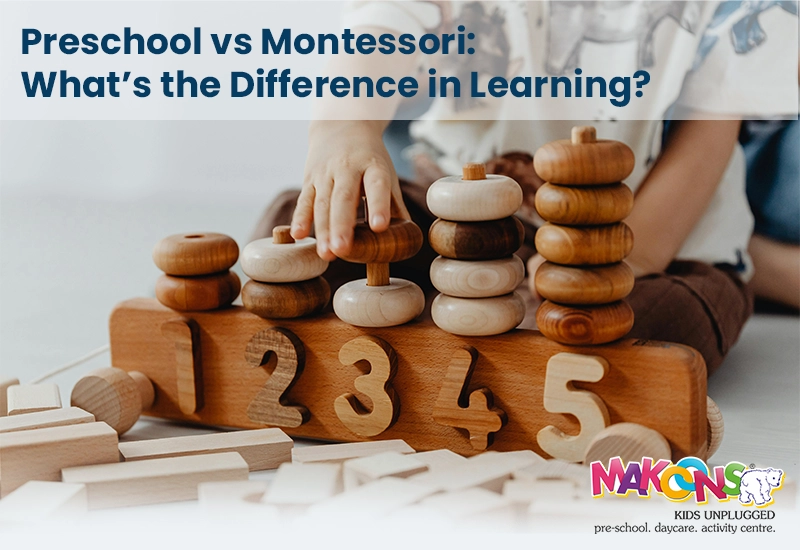
Early childhood education is important to determine the future of a child. Preschool vs Montessori tactics end up confusing some parents on the appropriate start of their small one. These two alternatives want to prepare children to enter formal schooling, even though there is a lot of difference in approach, philosophy, and environment.
The present article touches on the distinction between preschool and Montessori, juxtaposes the Montessori curriculum with the preschool curriculum, and tells what Montessori learning and preschool learning differ by.
Understanding Preschool
An early childhood education program is a preschool which is tailored at ages of two to five years. It is geared towards orderly learning, socializing, and getting kids ready to enter kindergarten.
Key Features of Traditional Preschool
1. Age-based classrooms – Children are grouped by age.
2. Teacher-led instruction – Teachers guide activities, lessons, and schedules.
3. Formal curriculum- Azimuths, alphabets, rhymes and even basic writing is taught.
4. The learning and play are combined-There is a combination of fun and academic development in activities.
5. Fixed schedule – Preschools tend to adhere to a schedule and program of lessons.
Conventional preschools focus on social learning, early education, and a creation of a routine so that a child is ready to live in school.
Understanding Montessori
The Montessori approach was invented by Dr. Maria Montessori in the early 20th century and it is a child-centered theory of child-education. Rather than exerting a universal approach, Montessori offers children independence to learn and discover in a well prepared environment.
Key Features of Montessori Learning
1. Mixed-age classrooms – Usually spanning 3 years (e.g., 3–6 years).
2. Child-oriented exploration– Children select the things they want to do.
3. Montessori materials – Special hands-on tools designed for self-learning.
4. Emphasize self-sufficiency -Children are taught how to accomplish tasks such as pouring, shoe-tying and clean-up activities.
5. Teacher as a guide – Teachers guide but do not direct.
Montessori stimulates inquisitiveness, personal accountability and problem solving, by allowing the practical life activities and drills that strengthen the senses singly.
Montessori Curriculum vs Preschool Curriculum
The greatest difference between the two can be showcased by the Montessori curriculum vs preschool curriculum.
Preschool Curriculum
- It is centered on the familiarity of the alphabet, counting, shapes and colours.
- Group activities such as storytelling, rhymes, and art projects.
- Emphasizes school readiness through structured routines.
Montessori Curriculum
- Divided into areas which are important: Practical Life, Sensorial, Math, Language and Culture.
- Uses self-correcting materials (like bead chains, sandpaper letters).
- Encourages children to move from concrete to abstract concepts.
- Includes real-life skills such as cooking, cleaning, and gardening.
Early academic education is pursued in the preschool but in the Montessori approach, the child is all rounded.
Montessori Learning vs Preschool Learning
- In examining Montessori learning and preschool learning the distinction is the role of the child in the classroom.
- Within preschool learning, kids learn according to a schedule and they learn collectively. The teacher sets the pace and guides the activities.
- In learning under the Montessori system, the children are given control of how they learn. They make decisions, work alone and become attentive because of the active exploration.
- Montessori has a greater degree of freedom and growth tailored to the child whereas preschools concentrate on the preparation of children in the traditional school.
Which is Better: Preschool or Montessori?
There is no universal answer—both have unique advantages.
Choose Preschool if:
- You desire a protocol program that would make your child ready for kindergarten.
- You prefer teacher-led instruction and set academic goals.
- You want an affordable and widely available option.
Choose Montessori if:
- It is your desire to have your child grow and become independent and in a capacity to make choices.
- You believe in self-paced, interest-driven learning.
- You like a learning experience focused on application in the real world and discovery.
Conclusion
No debate is being conducted on whether preschool or Montessori is the better one but rather what endeavors to fit the personality of the child and what the parent wants their child to learn. The most substantial distinction between preschool and Montessori is the manner of teaching, the organization of the classroom, and the way the curriculum is organized.
- Preschool helps to develop socialization, academic preparedness and organized learning.
- Montessori nurtures independence, problem-solving, and holistic development.
A parent must hear the distinction between the Montessori Curriculum and the preschool Curriculum as also the distinction between the Montessori learning and preschool learning so as to come to a good informed decision.
Read Also : Different Types of Preschool Programs -Montessori, Reggio, and Beyond
FAQs on Preschool vs Montessori
Is Montessori better than traditional preschool?
It depends on your child. Montessori is very good in grooming individuals who are independent and creative and preschool introduces them into formal school lives.
How does Montessori curriculum vs preschool curriculum differ?
The preschool curriculum consists of letters and numbers education, as well as working in groups, whereas the Montessori curriculum consists of practical learning and unique life skills, and supports personal development.
Which is more expensive: preschool or Montessori?
Montessori is more expensive due to special equipment, and trained educators.





 Twitter