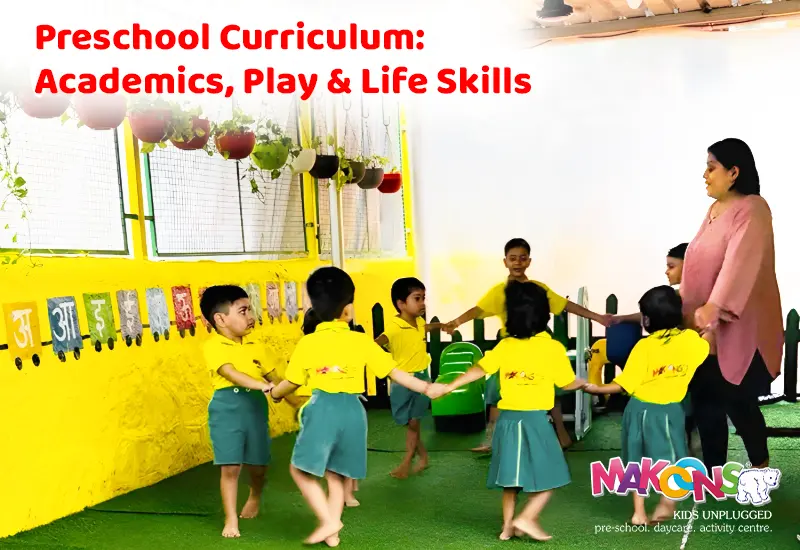
Childhood is an important point for children’s development and growth, and the educational program you take part in has a big influence on the child’s future. Preschool is a phase of whole-child growth which includes activities like storytelling, puzzles, painting, sharing toys, tying shoelaces, and alphabet songs. This guide will go over how a good preschool curriculum balances academics, play-based learning, and life skills to support children’s development in every field. Whether you’re a teacher creating learning strategies or a parent researching the curriculum for a nursery class, this article will give you a clear understanding of what matters most in early childhood education.
1. The Preschool Curriculum’s Foundation
Preschool, commonly referred to because kindergarten or play school, acts children ages two to five. Instead of being academic in the conventional sense, the school’s curriculum focuses on education which is developmentally appropriate and fosters the following: cognitive skills; language and communication; motor abilities; emotional intelligence; social interaction; and independence and life skills. A holistic curriculum that blends organized academic exposure with lots of exploration and play moments is suitable for kindergarten classes.
2. Preschool Academics: A Kind Introduction
Preschool exposes kids to fundamental academic ideas in order to get them ready for kindergarten the limit, even though it is not meant to be a demanding program.
a) Language and Literacy
• Name creating and basic tracing
• Rhymes, songs, and simple storytelling
• Phonics and letter sounds
• Awareness of the alphabet (A-Z, both capital and lowercase)
b) Numeracy Proficiency:
calculating from 1 to 20 (or beyond, based on the age group)Recognizing and classifying simple numbers, understanding shapes and sizes, and becoming accustomed to topics and examples (big/small, more/less) c) The awareness at The sum The names of fruits, vegetables, pets, body parts, colors, and seasons are discussed, along with day and night, the weather, and basic hygiene. Academic learning is always interactive, visual, and hands-on with the help of flashcards, storybooks, toys, and activities, which makes it fun and stress-free.
3. Play-Based Learning:
The basis of Early Childhood Education Play-based learning is a foundation of any in effect preschool course of study. It develops the children’s creativity, curiosity, problem-solving abilities, and collaboration with them having any idea they are studying. Play in kindergarten can take many different forms. Children may share views through pretend play, also called dramatic play, while they play with everyday activities like cooking, shopping, and doctor’s appointments. Playing with textured things, sand, water, or clay have become a few examples of sensory play activities that incorporate touch, sight, sound, or feel.
Examples of sensory play activities that integrate touch, sight, sound, or feel include playing with textured objects, sand, water, or clay.
• Constructive play: using LEGOs, puzzles, and building blocks to foster reasoning, creativity, and hand-eye coordination.
• Outdoor Play: Group games, running, jumping, and climbing are all ways to build cooperation as well as large motor abilities.
• Art and Music: Activities like coloring pages, puzzles, box construction, painting, and claying
At this age, children learn more through play than through formal education. It promotes emotional health and also prepares for school.
4. Life Skills in Preschool: Learning Beyond the Classroom
Preschoolers need to learn life skills as well as studying and calculating in order to become independent and confident.
a) Self-care skills include using a spoon or fork, when eating, cleaning up immediately after using the restroom, brushing your teeth, and washing your hands; opening lunchboxes; and putting on clothes and shoes.
b) Social skills include saying “yes” and thanks to the people, sharing toys in a shared way, controlling emotions, and following social norms and rules.
c) The ability to be emotionally intelligent Young children learn to identify and express a range of emotions, including happiness, sadness, anger, and frustration.. Teachers assist students via words to communicate feelings, settle disputes, and grow in empathy.
d) Understanding and Security
Children are taught the fundamentals of safety, including:
• Maintaining in educational institutions boundaries; understanding warning signs as engaging outside; Avoiding approaching strangers; or
• Seeking help when needed. Understanding your ABCs and 123s is as important as those practical instructions.
5. Structure of a Preschool Day
a little established routines, an efficient preschool day strikes a balance between education and recreation. This is an example of a schedule:
Time – Activity
9:00 – 9:30 – Arrival & Free Play
9:30 – 10:00 – Circle Time (Rhymes, Stories)
10:00 – 10:30 – Academic Block (Numbers/Letters)
10:30 – 11:00 – Snack Break
11:00 – 11:30 – Outdoor Play
11:30 – 12:00 – Art or Music Time
12:00 – 12:30 – Life Skills/Role Play
12:30 – Wrap-up & Home Time
Establishing consistent daily routines gives children an understanding of safety or instructs them about time and responsibility.
6. Role of Teachers and Environment
A secure, kid-friendly Setting up and having qualified teachers are also essential components of a top-notch preschool curriculum. As facilitators rather than teachers, teachers lead children through experiences, model behavior, and promote inquiry. The following are crucial elements of a caring preschool environment: Classrooms that are lively and engaging; safe playthings and furnishings; easily accessible educational materials; displays of children’s artwork; and hygienic and neat facilities Parents should look for schools that place equal emphasis on education or emotional assistance.
7. Integrating Modern Tools and Technology
Age-appropriate online resources are frequently utilized by current preschools to improve instruction. This includes digital storytelling, supervised instructional apps, learning words that rhyme and videos, and active whiteboards. Screen time is restricted and balanced with exercise to prevent overexposure.
8. Parental Involvement in the Educational Process
A child’s preschool experience is enhanced by parental involvement. Weekly updates, progress reports, parent participation in theme days or festivals, and parent ideas for at-home expansion projects are all things that schools should do. A child feels safer and more accepted when their home and school environments complement each other.
Conclusion
In order to sum up, a strong foundation for lifelong learning Building the foundation over lifetime abilities was far more significant in a well-designed preschool curriculum instead of teaching letters and numbers. Early childhood education develops well-rounded, self-assured, and inquisitive people by combining academics, play-based learning, or life skills. Families are not to worry if their child fails to write properly or study effortlessly by the end of preschool. What really matters most is a desire for studying, mental health, and ability to adapt, all of which are provided by a strong curriculum.
Read Also : Top 10 Activities Every Preschool Curriculum Should Have







 Twitter