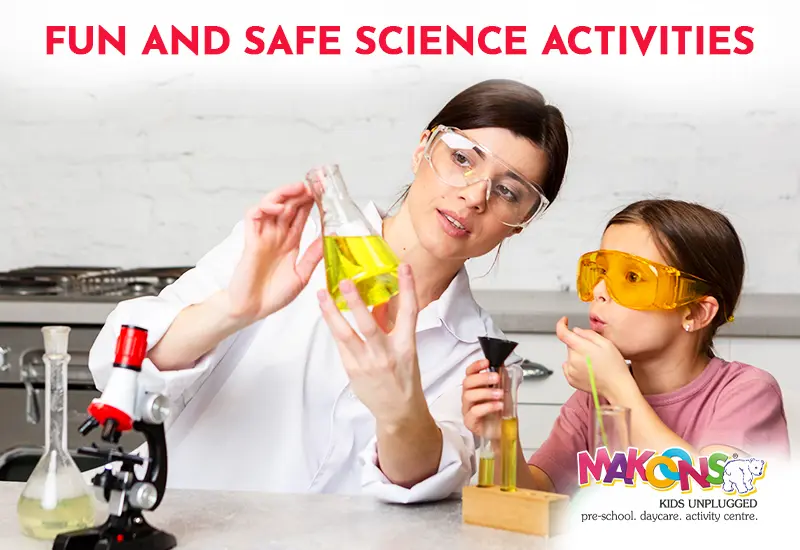
Science should not be limited to labs and white-coated adults. For toddlers and preschoolers, science is everywhere and anywhere—in the water they splash, the bubbles they blow, and even in the shadows they chase. Complex theories are not even necessary for exposing children to science at this young age. It entails interesting, enjoyable, and practical activities that pique their innate curiosity. This blog will discuss safe science projects for kids as well as entertaining science activities for toddlers. Prepare to transform your house into an amazing miniature laboratory!
Why Science Matters in Early Childhood?
Let’s first discuss the importance of science in early learning before getting into the experiments. Children are like sponges when they are young. They constantly look, feel, taste, and investigate their environment. We assist them by introducing science fun for early learning.
- Develop problem-solving skills
- Enhance language and communication
- Boost fine motor skills
- Build confidence through exploration
- Learn how to ask questions and seek answers
What is the best way to begin, then? through safe and enjoyable hands-on science education for preschoolers.
1. Rainbow Walking Water
This exercise serves as a vibrant introduction to colour mixing and capillary action. Some Paper towels, food colour, and clear cups are all you’ll need.
How to do it:
Fill three cups with water and add red, yellow, and blue food coloring to each cup respectively.
Place an empty cup between each colored one.
Roll paper towels into strips and place them like bridges between the cups.
Watch as the colors “walk” and mix into the empty cups!
One of the most popular preschool science experiments is this straightforward one that teaches colour theory and fundamental absorption concepts.
2. Bubble Science Fun
Children adore bubbles! So why not use their bubble play to subtly introduce some science?
Materials needed:
Dish soap, water, sugar or glycerin, and bubble wands.
What they learn:
Youngsters gain some knowledge of surface tension, air trapping, and the causes of bubbles with the help of this experiment. It’s a fun way to combine science and play. It is also a kid-safe science project because it only involves soap and water.
3. Dancing Raisins
This one is magic in a glass—well, almost!
Supplies:
- A clear glass
- Soda or sparkling water
- A few raisins
Instructions:
Wait after dropping the raisins into the soda. As the carbonation raises and then lowers them again, you’ll see them dance up and down.
This is one of the simplest science activities for toddlers and a fun way to introduce the concepts of gas and buoyancy.
4. DIY Lava Lamp
A captivating experiment that creates a cool display by combining colour, oil, and bubbles
Materials:
- A clear bottle or jar
- Vegetable oil
- Water
- Food coloring
- Alka-Seltzer tablets
Steps:
Fill the bottle ¾ with oil and the remaining with water.
Add some drops of food color.
Watch the lava show start when you drop an Alka-Seltzer tablet in half!
This experiment uses visuals to teach density and chemical reactions.
5. Sink or Float?
This is a traditional exercise that teaches the ideas of prediction and buoyancy.
What you need:
- A tub of water
- Random safe objects: spoon, leaf, plastic toy, pebble, etc.
Instructions:
Before you drop each object in, let your child guess if it will float or sink.
Preschoolers benefit from this kind of practical science because it improves their vocabulary and reasoning in addition to their ability to observe.
6. Melting Ice Rescue
Perfect for hot days and equally fun indoors!
Supplies:
- Small toys or plastic animals
- Ice cube tray
- Water
- Salt and warm water in squeeze bottles
What to do:
Freeze the toys in ice overnight.
Give your child salt and warm water to “rescue” the toys from the ice.
It’s an excellent method of showing how heat and salt impact ice. The fun is further enhanced by the tactile experience.
7. Magnetic Magic
Introduce the concept of magnetism through play.
Materials
- A magnet wand
- Metal and non-metal household items
- A tray or basket
Activity:
Encourage your child to investigate which objects the magnet can and cannot pick up. Classifying objects accordingly gives this game a cognitive edge.
This easy and simple activity introduces foundational science concepts in a fun, interactive , engaging way.
8. Growing Seeds in a Bag
Watch life begin right in your window!
Materials:
- Ziplock bag
- Wet paper towel
- Bean seeds
- Tape
Steps:
Put a few seeds on the bag’s wet paper towel and secure it with tape to a window that receives plenty of sunlight. Your child will witness the formation of roots and sprouts in a few days.
It’s an excellent method of teaching early science lessons about plant life cycles and responsibility.
9. Shadow Tracing
This is a great combination of art and science.
What you need:
- Paper
- Toys or objects with distinct shapes.
- A sunny day or flashlight
- Pencil and crayons
What to do:
Position the item in that manner so that the paper is shadowed by it. Allow your kid to follow the shadow. After some time, return and observe how the shadow has changed according to time .
This exercise introduces the idea of light, time, and spatial awareness.
10. Volcano Eruption
This classic vinegar and baking soda volcano eruption never fails to delight.
Materials:
- Baking soda
- Vinegar
- Food color
- A plastic water bottle
- Clay to shape the volcano (optional)
Steps:
Pour some amount of vinegar into the bottle after adding colour and baking soda, then just observe the eruption!
Under the supervision of an educator, preschoolers can safely enjoy this entertaining and beautiful explosion, which serves as an excellent introduction to multiple chemical reactions.
Tips for Safe Science Fun at Home
Safety must be a top priority when performing science activities with toddlers..
- Always supervise them during experiments.
- Avoid small parts that can cause choking hazards.
- Use non-toxic materials only for the experiment.
- Teach cleanliness: washing hands before and after completing an experiment is always a must.
Final Thoughts
Early childhood science is never about facts and formulas. Its focus is all about exploration, wonder, and discoveries. Basically, you’re laying the foundation for a lifelong love of learning with these kid-friendly science projects which are interesting as well as engaging.here each and every moment becomes an opportunity to learn and develop.
So let your hands get dirty, gather some very basic materials, and explore the world of science experiments for young kids . Not only are you creating some mess, but you’re learning, creating memories, and sowing the seeds of lifelong curiosity in their minds.
Let the science fun begin!
Read Also : Easy and Interesting Science Questions for Kids with Answers







 Twitter