Have you ever seen a child pick up a pencil for the first time and attempt to sketch something? It’s a little messy but also endearing. This is due to the fact that writing is a process that is developed gradually. Children must learn something more basic—lines—before they can write letters or numbers.
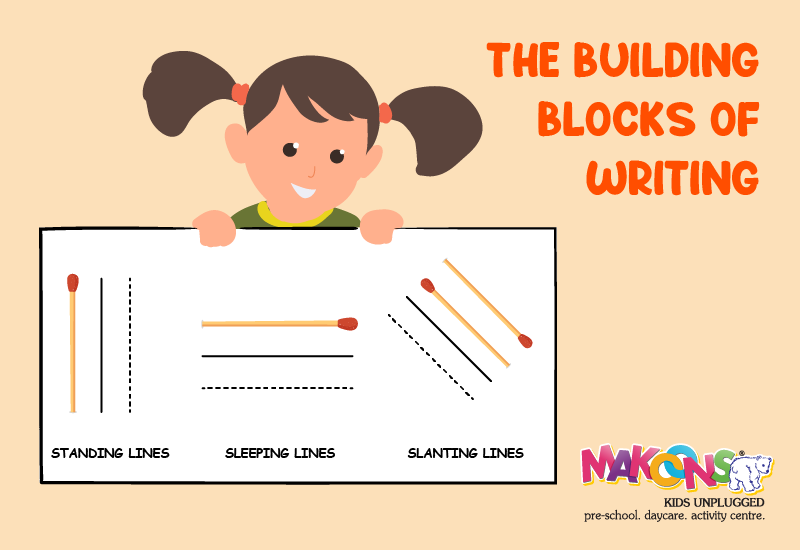
Yes, only basic lines: slanting, sleeping, and standing lines.
These aren’t just some random strokes. They serve as the base for writing and are important in helping kids develop their pre-writing abilities. Therefore, knowing the function of these lines will help create a solid basis for neat handwriting and improved learning, regardless of whether you are a parent, teacher, or preschooler’s guide.
Let’s dive into this world of lines, curves, and creativity.
The Significance of these Lines in Early Preschool phase must comprehend the basic fundamental shapes that make up different letters like “A,” “T,” and “Z” before they can perfectly write them. The majority of these are created with slanting, sleeping, or standing lines. Without becoming a master of these basic yet important strokes, writing becomes an easy task for young children.
Preschoolers yet aren’t well prepared to write complete words or a new sentence, and that’s completely okay. However, they can still learn how to hold a pencil, how to draw a straight line, and join different lines in multiple directions. These are important for their upcoming future academic success and they fall under the category of what teachers refer to as pre-writing skills for Preschoolers.
Standing Lines: The Straight-Ahead Friends First, let’s talk about the standing queue. Simple, clean, and self-assured, it’s a straight line drawn from top to bottom..
Imagine the letter ‘L’ — There is a standing queue at the start. Consider the letters “T,” “H,” and “I,” which all employ this vertical stroke.
Children learn to control their pencil strokes in a straight downward motion by practicing standing lines. This provides the development of these three important aspects of fine motor skills: hand strength, wrist stability, and good coordination.
Some fun ways to practice standing lines include:
- Drawing raindrops falling straight down.
- Making tall trees with vertical trunks.
- Using chalk to draw on walls or blackboards from top to bottom.
Sleeping Lines: Horizontal Heroes
The sleeping line comes next; it is a line that is flat from left to right, resembling a person taking a nap after a long day. Letters like “E,” “F,” “H,” and “Z” have these horizontal lines.
Children who love to learn and practise sleeping lines are better able to control their movement, lateral movement. which is important when they start writing letters on paper or in a textbook.
Some engaging activities include:
- Drawing the horizon in a landscape.
- Connecting dots in a straight row.
- Tracing lines on a sand tray from one side to the other.
These enjoyable activities enhance visual tracking, a significant early reading and writing milestone, in addition to writing abilities.
Slanting Lines: The Dynamos in Diagonal
The slanting line is the exciting and challenging part. This line leans / slant at a particular angle, resembling the sides of a triangle. Slanting lines are used to form letters such as “A,” “V,”and “X.”
Children gain knowledge about how to mix and blend horizontal and vertical type motion into a single fluid type motion with this line. In the beginning it may find it a little difficult, but with some amount of practice, it becomes a favourite!
Great ways to explore slanting lines include:
- Drawing mountain peaks.
- Making zig-zag patterns.
- Tracing slanting lines using colored markers and fun worksheets.
Youngsters adore the creativity and challenge these lines provide. Additionally, they will have already completed half of the foundational handwriting skills they will need for school once they have mastered them.
Increasing Self-Belief Through Line: Practice Writing is a difficult art. However, it becomes manageable and even fun when divided into easy steps, such as practicing the preschool queue. When kids are able to draw these lines:
- They gain fine motor control.
- They develop hand-eye coordination.
- They generate muscle memory for new future writing tasks.
Writing preschool lines can be done in a variety of different ways, including different art projects, a lot of outdoor games, some sensory play, and also basic paper-pencil exercises. Making it entertaining and interesting is crucial and very important.
Ask preschoolers to use chalk, paintbrushes, crayons, or even stick and fingers in flour or sand. Make each and every line a narrative; such as, a slanting line could be a ramp, a sleeping or laid line a road and a standing straight line a tall tree.
Combining Lines to Create Letters Children can begin combining lines once they are comfortable with each one alone. For instance:
- The letter A = two slanting lines + one sleeping line.
- The letter H = two standing lines + one sleeping line.
- The letter K = one standing line + two slanting lines.
This is when the real magic of writing begins.
Children can eventually write letters, numbers, and even their names by connecting these strokes. And the solid basis of line practice is the source of all of this. It is evidence that even something as basic as a line can unleash a vast array of creative possibilities.
Prewriting Techniques at Home and in School Children can be assisted in acquiring these fundamental abilities by both parents and teachers. This is how:
At home:
- Create a “line of the day” activity.
- Use playdough to form standing, sleeping, and slanting shapes.
- Make wall charts showing each line and where it appears in letters.
At school:
- Include line drawing in morning routines.
- Provide tracing worksheets with fun themes.
- Set up fine motor stations with activities like lacing, cutting, and tracing.
The intention is to make learning enjoyable rather than stressful by regularly but playfully reinforcing these skills..
Conclusion:
Long before a child writes their first sentence, the path to beautiful handwriting starts. It starts with the unsung heroes of early literacy: standing, sleeping, and slanting lines.
Focussing on pre-writing skills for children fosters confidence, coordination, and a love of writing in addition to teaching lines.
Thus, smile the next time your child makes a line on paper. A lifetime of learning begins with that tiny line.
Read Also : 35 Fun Questions to Spark Conversations with Kids







 Twitter