Have you ever observed how children are inherently drawn to shadows? Children are immediately captivated by this enchanted interplay of light and darkness, whether they are chasing their own on a sunny day or using a torch to create hand puppets on the wall. When light and shape combine to create a beautiful, playful, and educational world, shadow art for children becomes the ideal fusion of education and enjoyment.
We’ll delve deeply into the intriguing realm of shadow play in this blog and uncover imaginative indoor art projects that require only basic supplies and a lot of creativity. Shadow art can transform routine afternoons into remarkable experiences in a variety of fields, including science and craft and storytelling.
What is Shadow Art?
Children can use a variety of objects and light sources to create unique shapes, or even a whole scene with shadow art. This type of art, as opposed to traditional art like drawing or painting, allows children to find how light functions, how different shapes respond to light, and how movement can alter the shape of a shadow.
It’s more than just a simple art; it’s a beautiful mixture of science, narrative, and play.
Why Shadow Art is Great for Children?
Making shadows move across walls has a certain enchantment. Beyond its aesthetic appeal, shadow art for children has several advantages:
Boosts Creativity: Kids can also use shadows to create and imagine objects or new characters. It encourages and enhances them to use their imagination skills in new ways, whether they are creating scenes or narrating fake news stories.
Encourages Scientific Thinking: Children learn new things about light sources, opacity, angles, and reflection through light. What are some essential concepts of science.
Perfect Indoor Play Idea: New indoor play ideas like shadow art are very helpful when outdoor play isn’t possible due to factors like rainy days, hot afternoons, or just a lack of space in the locality.
Improves Motor Skills: Kids can also improve their fine motor skills as they cut different new shapes, trace shadows, and construct new props.
Facilitates Storytelling: With just a source of light and cutouts, children can also create miniature theatrical productions through a shadow play. It’s an enjoyable and interesting method to hone your storytelling and speaking abilities.
How to Start with Shadow Art at Home?
Children can also experiment with shadow art without the need for costly kits or specialised equipment made for only shadow art. All you need is a torch, a plain wall, and a few common household objects to create shadow puppets.
1. Set Up a Light Source
Make some use of your table lamp, torch, or even sunlight coming in through a window or door . Early morning or late afternoon, when the sun is angled perfectly, is considered the ideal time of day for natural shadows.
2. Choose or Create Objects
Toys, hands, cutout shapes, or even cardboard characters can be used. Children should be encouraged to experiment with various objects to observe how the shadows change.
3. Play and Observe
Adjust the distance between objects and the light. Rotate, tilt, and stack them. Allow children to see how the size and shape of the shadow change.
4. Trace the Shadows
Have your child trace the outlines on a piece of paper that is behind the shadow. Later on, they can colour them or make up a narrative about them.
Popular Shadow Art Activities for Kids
Let’s examine a few enjoyable light and shadow exercises that are simple to attempt and offer a wealth of creative possibilities:
Shadow Drawing
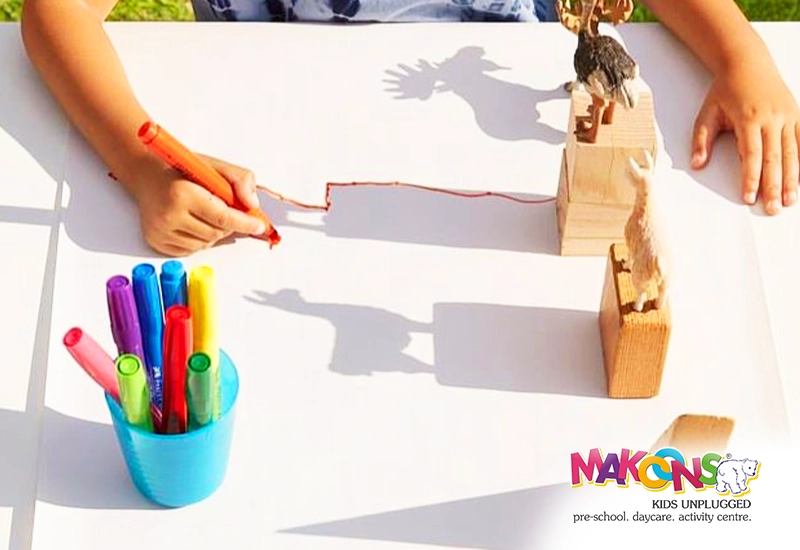
With a torch shining on them, place toys (such as dolls or animal figures) on a table. Allow children to trace the shadow by taping paper behind them. These outlines can be transformed into a fantasy world, a cityscape, or a jungle!
Hand Shadow Puppets
A timeless classic that never goes out of style. Show children how to make characters and animals with their hands. You can make your own DIY puppet theatre with just a torch and a blank wall.
Shadow Sculptures
Ask your kid to use LEGOs, blocks, or maybe straws to build towers or abstract shapes of different shapes. Examine the distinctive shadows they create by shining a light behind them . It’s similar to using light to create 3D art!
Shadow Stories
Make some shadow puppets out of old cardboard or black paper using different characters, new props, and even some scenery. To make a shadow play, shine a light behind a bedsheet or a curtain. Allow your kid to act out fairy tales, play characters, or narrate their own stories. Shadow play turns into performance art at this point.
Nature Shadows
On a walk, gather flowers, twigs, feathers, and leaves. Let children trace their delicate outlines on paper in the sun at home. It’s an amazing combination of art and nature.
Turning Shadow Art into a Learning Experience
It’s easy and fun to incorporate basic learning ideas into shadow art:
Math: At various times of the day, measure the length of the shadow. Introduce some new concepts such as direction, angle, longer, and shorter.
Science: Talk about the causes of shadows, and why shadows are formed. the difference between opaque and transparent objects, and the motion of the light.
Language Skills: Encourage young children to use their shadow art creations as the inspiration and motivation for a poem or short story.
Art and Designs: You should discuss symmetry, contrast, negative space, and different new silhouettes. These are some mocked early design concepts.
Shadow Art as a Rainy Day or Indoor Play Idea
Screens frequently take precedence when kids are cooped up indoors. However, children’s shadow art provides a creative, screen-free substitute. Shadow play turns idle time into exploration, whether it’s during a quiet evening, a playdate, or a school break.
Here’s why it’s one of the best indoor play ideas for kids:
- No mess or clean-up involved
- Requires very few materials
- Can be adapted for solo or group play
- Fits different age groups easily
- Ideal for apartments and small homes
With the help of a torch, even a dim closet can be transformed into a beautiful shadow theatre. Your hallway passage can become a gallery, your kitchen wall a canvas for painting, and your living room can become a stage with a little planning and creativity.
A Few Tips to Make Shadow Art More Interesting and Engaging
- Use coloured cellophane or transparent sheets to add colour to shadows.
- Introduce music to enhance the mood during shadow storytelling.
- Let children make their shadow boxes using shoe boxes and tracing paper.
- Also, you can combine it with other different crafts—like making dioramas or using glow-in-the-dark type paint.
- Take pictures of the shadow art, and you can also create a digital album or maybe a printable storybook.
Final Thoughts
Kids shadow art makes a lovely and imaginative environment where creativity blooms in a world of fixed education and screen-based entertainment. It’s easily accessible, reasonably priced for the middle class , and incredibly enjoyable. More importantly, it mixes art, science, and storytelling in a way that promotes interest and makes people happy.
Thus, the next time you’re finding and searching for something new, interesting, and entertaining to do inside the house, get a torch and some toys, and let the light lead its way. Kids can also create whole worlds using only different shapes and shadows, and they can learn more than they ever thought.
It’s worth experimenting with different colour lights and shadow activities, whether you’re a guardian, teacher , or just someone who appreciates and loves creative play.
Let the shadows tell your story.
Read More – 15 Easy Drawing Ideas for Kids







 Twitter